

Invitation to Japan

Updated: Jul 20
What I Learned from Kikuichi's Master Craftsmen, 750 Years of Tradition, and the Never-Ending Pursuit of Sharper Knives
As professional sharpeners, we spend our careers learning from every knife that crosses our workbench. Some lessons come from damaged blades. Others come from years of repetition, tiny adjustments, and thousands of hours spent listening as much as looking. And every once in a while, an opportunity comes along that changes the way you think about your craft forever.
I was deeply honored to receive an invitation to participate in an intimate workshop with the master craftsmen of Kikuichi in Nara, Japan.
Founded in 1267, Kikuichi is the world's oldest continuously operating blade makers. Their history stretches back more than 750 years to the Kamakura period, when members of the Kikuichi family forged swords under the patronage of Emperor Go-Toba. Today, many of their knives still bear the Imperial Chrysanthemum crest which is a reminder of that remarkable heritage and a symbol of craftsmanship that has been passed from one generation to the next.
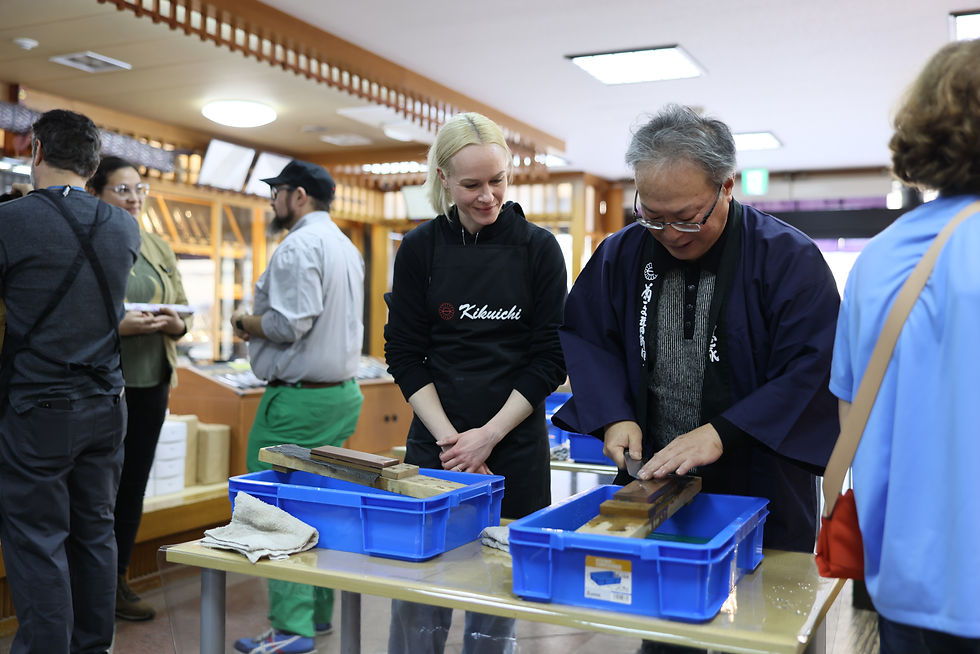
For someone who has spent seventeen years sharpening professionally, it was a privilege beyond words.
Arriving in Japan
I traveled with one of my closest friends, Milwaukee photographer Robert Remme, who generously documented the experience, and we arrived a few days before the workshop began.
Before the workshop, we met up with Michael Behn of Moshi Moshi (a talented fellow sharpener with a great sense of humor) and traveled by train to Osaka (the stories are true! Japanese trains really do arrive with astonishing precision) to visit Sennichimae Doguyasuji, Osaka's famous kitchenware district.
I've spent nearly two decades around knives and sharpening equipment, but I'd never seen anything quite like it. Store after store displayed handcrafted kitchen knives, whetstones, woodworking tools, and equipment representing generations of Japanese craftsmanship. It felt less like shopping and more like walking through a living museum. It quickly became clear that in Japan, craftsmanship isn't simply appreciated, it’s woven into everyday life.
Learning from Masters
Our workshop consisted of a small group of invited American knife professionals. Rather than lectures, we were welcomed directly into the workshops of the people who have spent decades, and in many cases generations, perfecting their craft.
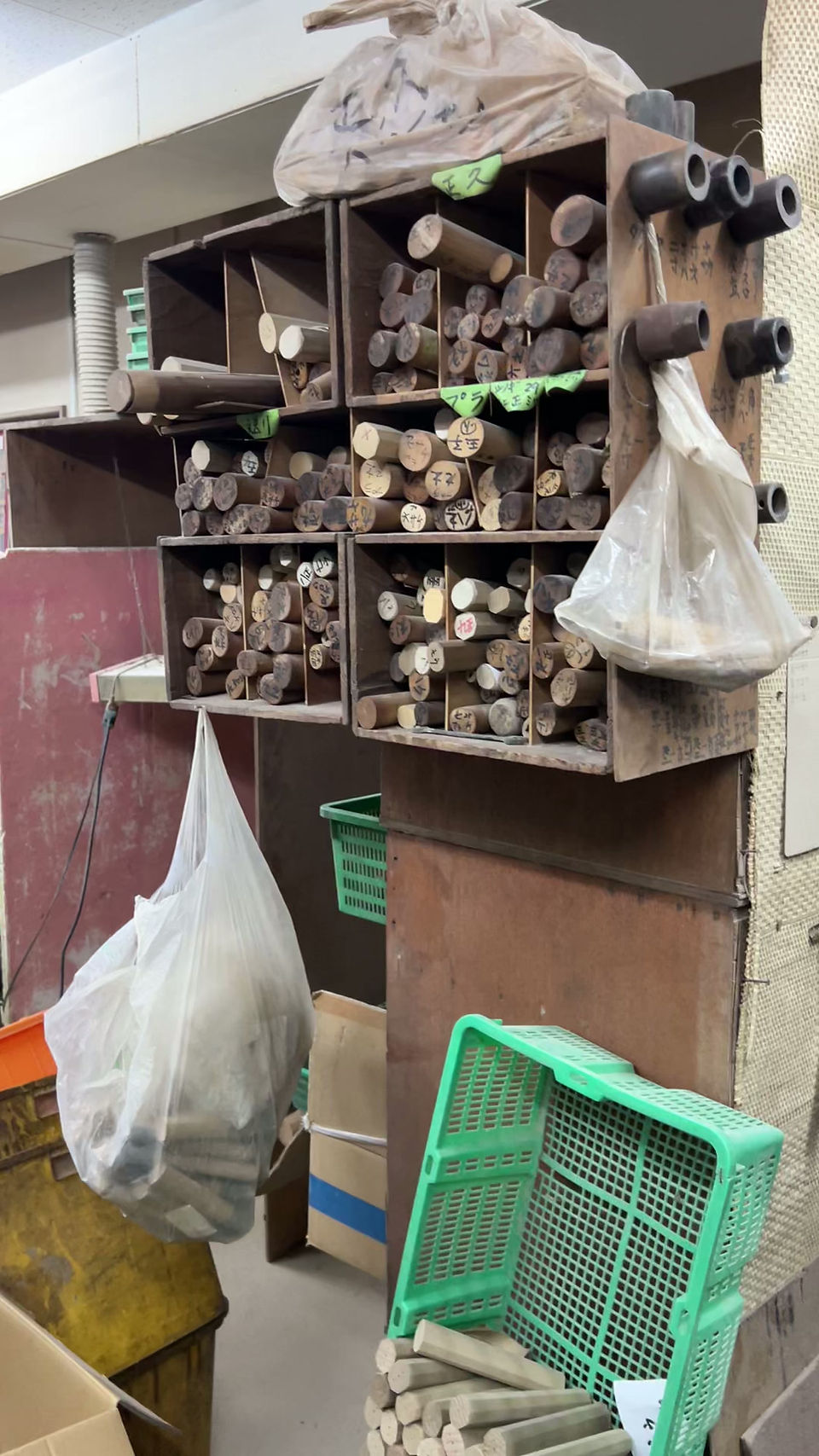
The first stop was Kikuichi's handle makers. Watching an experienced craftsman transform a simple block of wood into a perfectly balanced octagonal handle without a template or guide was mesmerizing. Every movement appeared effortless, yet every detail reflected thousands of hours of practice.

From there we visited the Sakai Traditional Crafts Museum, which beautifully preserves the history of one of Japan's most respected knife-making regions. One quotation displayed in the museum has stayed with me ever since.
Master Sharpener Mamoru Morimoto-san wrote:
"My training as a sharpener is never ending. I will continue to face the work day after day."
I couldn't imagine a better description of this profession. People often assume knife sharpening is a straightforward skill that can be mastered quickly. The reality is quite different. Every blade behaves differently. Every repair presents a new challenge. Even after seventeen years, I continue learning something new almost every week. That quote perfectly captured the mindset shared by everyone we met.
Fire, Steel, and Generations of Knowledge
After lunch we entered the forge of fifth-generation master bladesmith Tadashi Enami-san. Standing inside a workshop where techniques have been passed from so many generations to the next is difficult to describe.
We watched then participated in hammering, cutting, and forging the carbon steel until it transformed into blades that would over the course of this trip become our most prized kitchen tool. Each step balanced science and art with intuition.

Although modern machinery certainly has its place, the remarkable part wasn't the equipment, it was the people operating it. Nearly every decision was made through experience, observation, and touch. It reminded me that the best tools in any workshop are still human hands.
Our Kindred Spirits Across the Globe
One realization stood out immediately. There were no sharpening guides. No angle jigs. No shortcuts. Instead, everything depended on sight, sound, feel, and years of developed muscle memory.
That was one of the most meaningful moments of the trip for me as we have this in common at Moleta. Seeing many of these same principles reflected in the work of Kikuichi's master sharpeners was incredibly encouraging. Not because it meant we'd "figured it out," but because it reminded me that when craftspeople devote themselves to quality, careful observation often leads them toward similar solutions.
Over the years at Moleta, we've developed our sharpening process through thousands of hours of experience, careful observation, and studying both Japanese and Italian sharpening traditions. While we use modern belt grinders, the descendants of traditional foot-powered grinding wheels, our goal has always been the same: remove only the steel that's necessary while preserving the life of the knife.
Rather than sharpening every section of a blade identically, we evaluate each portion independently. Areas with chips or damage may require more work, while healthier sections are preserved all while maintaining the working profile appropriate for that blade. This approach allows us to restore cutting performance while removing as little material as possible.
One topic we were excited to connect with was something many people never think about.
Sound.
Professional sharpening isn't only visual. The sound a blade makes against a grinding surface reveals an incredible amount of information. An experienced sharpener can often hear subtle differences in blade thickness, pressure, contact, and consistency long before they're obvious to the eye. That becomes especially valuable when repairing damaged knives, correcting uneven bevels, or restoring worn bolsters.
Like many traditional crafts, sharpening is as much about developing your senses as it is about learning techniques. It's difficult to explain until you've spent years doing it. As our sharpener Frank humorously said one day after training for hundred of hours that suddenly one day it clicked and he “felt like a Jedi…like I’m one with the blade”.

Finishing the Knife
That evening, we visited master craftsman Akimasa Ohe-san, who inspected our blades before teaching us how to fit the handles and perform the final engraving. Watching him hand-chisel characters into hardened steel with absolute precision and confidence was amazing to watch.

Then came the final day. Before returning to Kikuichi headquarters, we visited beautiful Nara Park and Todai-ji Temple, two places that perfectly reflect the history and quiet beauty of the region.
Back at Kikuichi, we completed the final whetstone sharpening of the knives we had forged ourselves. Holding that finished knife for the first time is a moment I'll never forget. Not because it was perfect, but because I now understood how many skilled hands, specialized craftspeople, and generations of knowledge had been shared to create my knife.
Japanese Hospitality
The craftsmanship was unforgettable. The people were even more so. Throughout the workshop we were guided by Ikuyo Yanagisawa-san, the fourth-generation leader of Kikuichi and the first woman to lead the company. Her warmth, generosity, and enthusiasm shaped the entire experience.
Everywhere we traveled, people treated us with remarkable kindness.
Once everyone learned I was from Wisconsin, and that I thouroughly enjoy sake, it somehow became a running joke that two glasses would appear at every meal. We really do have a reputation that has traveled far and wide.
I found myself surrounded by people who take genuine pride in doing ordinary things extraordinarily well. Whether arranging merchandise in a shop, preparing a meal, forging a blade, or sharpening a knife, there was a shared belief that every task deserves care. That philosophy resonated deeply with me.
Bringing Those Lessons Home
People sometimes ask what changed after visiting Japan. The answer is both simple and difficult. We didn't come home and reinvent how we sharpen knives. Instead, the trip reinforced something I'd believed for many years: Quality is never accidental. It comes from patience, paying attention, and a refusal to stop learning.
The knife I forged in Japan is displayed at our shop today so that it can be shared before I one day take it home. it reminds me that no matter how much experience we gain, there is always more to learn.
Master Morimoto's words continue to echo in my mind:
"My training as a sharpener is never ending."
I hope I can always say the same.
Planning Your Own Visit
If you ever have the opportunity to visit Japan, I can't recommend Nara highly enough. Especially those of us from Milwaukee, it gives a whole new meaning to “Deer District”.

A visit to Kikuichi offers far more than shopping for a knife, it’s an opportunity to witness centuries of craftsmanship that continue to thrive today.
I came home with a blue carbon steel nakiri that has completely transformed the way I cook. Every time I reach for it, I find myself thinking less, "I have to make dinner," and more, "I get to use my knife!"
If a trip to Japan isn't on your calendar just yet, we'd be delighted to introduce you to Kikuichi here in Wisconsin. We proudly carry their handcrafted knives at Better Knife & Kitchen Store, and at Moleta we're honored to care for knives from every maker through our professional knife, scissor, and garden tool sharpening services, whether you visit us in person or use our nationwide mail-in sharpening service.
Thank you for letting me share one of the most meaningful experiences of my professional life and I hope we see you (and your blades) soon!


Comments